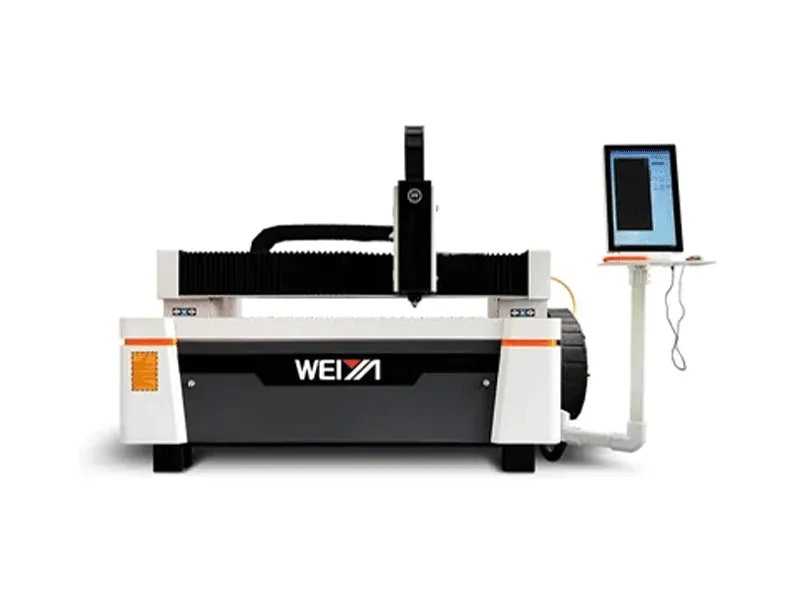
Stainless steel laser cutting is a precise manufacturing method used to produce clean, accurate, and repeatable parts for kitchenware, medical devices, and industrial fabrication. It supports hygienic design, tight tolerances, and refined edge quality, making it a strong fit for WEIYA and for other manufacturers serving demanding markets.
For food-contact and hygienic applications, stainless steel is highly valued for its corrosion resistance, non-porous surface, and ease of cleaning. Laser cutting helps preserve these advantages by delivering accurate geometry and reducing the need for heavy post-processing. In medical and industrial environments, the same process improves fit, consistency, and production efficiency.
What Stainless Steel Laser Cutting Is
Stainless steel laser cutting is a CNC-controlled thermal cutting process that uses a focused laser beam and assist gas to cut stainless steel sheet or plate into precise shapes. It is widely used because it produces narrow, clean cuts with strong repeatability and consistent results across production runs.
Industry references commonly describe standard tolerances in the range of a few tenths of a millimeter, with tighter accuracy possible under optimized conditions. Actual performance depends on machine quality, material thickness, fixturing, and part geometry. For food-contact stainless steel, smooth surface finishes are especially important, and hygienic design guidelines often emphasize low surface roughness for product-contact areas.
Stainless Steel Laser Cutting in Kitchenware Manufacturing
In kitchenware manufacturing, stainless steel laser cutting is used to produce hygienic, visually refined parts for cookware, utensils, sinks, appliances, and commercial kitchen equipment. It is especially useful for producing utensil bodies, perforated strainers, appliance panels, brackets, and decorative components that require smooth geometry and repeatable fit.
This process is important because food-contact parts must be easy to clean, corrosion resistant, and less prone to residue buildup. Stainless steel grades such as 304 and 316 are widely used in food-related applications because they are durable, non-porous, and well suited to hygienic environments.
Stainless Steel Laser Cutting in Medical Applications
In medical manufacturing, stainless steel laser cutting is used to produce precision parts that require tight fit, clean edges, and dependable consistency for patient-facing equipment and devices. Common applications include tubes, brackets, housings, and instrument components where burr-free edges and controlled heat input are essential.
Medical product categories rely heavily on stainless steel because of its cleanliness, corrosion resistance, and suitability for sterilization. The main advantages of laser cutting in this field are high accuracy and minimal deformation, which help maintain smooth finishes and support easier cleaning and sterilization.
Stainless Steel Laser Cutting in Industrial Fabrication
In industrial fabrication, stainless steel laser cutting is used to produce structural parts, enclosures, frames, brackets, and custom components with strong repeatability and low waste. Fabricators value the process because it supports complex shapes, reduces the need for secondary machining, and delivers clean edges ready for assembly.
For production teams, this often means faster turnaround, more consistent fit-up, and fewer finishing steps. Stainless steel also performs well in harsh or washdown environments, which makes laser-cut fabricated parts especially practical for industrial use.
Why Stainless Steel Laser Cutting Improves Accuracy
Laser cutting improves accuracy by concentrating energy into a narrow beam controlled by CNC motion, which reduces kerf width and improves repeatability. Compared with many traditional cutting methods, it offers tighter dimensional control, especially on thin to medium stainless steel parts. Digital programming also reduces operator variation and makes it easier to repeat hole spacing, nesting, and contour quality across high-volume production. That is why laser cutting is often chosen for parts that need to fit together with little or no adjustment.
How Stainless Steel Laser Cutting Supports Hygiene and Finish
Hygiene and finish refer to surface quality, cleanability, and resistance to contamination after cutting and post-processing. Stainless steel is widely used in food and medical environments because it resists corrosion, does not absorb moisture, and can be finished to a smooth surface that is easier to sanitize.
Laser cutting supports these advantages by reducing burrs and helping preserve cleaner edges. It also minimizes surface damage that could otherwise trap residue or complicate cleaning. In practice, a well-cut part can move more quickly into polishing, passivation, or assembly than a rough mechanically cut part.
Key Design Considerations for Stainless Steel Laser Cutting
Key design considerations include material grade, geometry, tolerance, hole size, minimum feature width, and surface finish requirements. For food and medical components, cleanability and surface smoothness are often just as important as dimensional accuracy, while fabrication parts may prioritize speed, cost, and weldability.
Good design also helps reduce heat distortion, avoid overly small features, and determine whether the part will be welded, polished, passivated, or assembled immediately after cutting. These details matter because post-cut finishing can affect hygiene, corrosion resistance, and final appearance.
Conclusion
Stainless steel laser cutting is a practical choice for kitchenware, medical devices, and industrial fabrication because it combines precision, hygiene, and efficient production. When paired with the right material grade, finish strategy, and design rules, it helps manufacturers deliver stronger-performing parts with better market appeal.