Choosing between a 5 axis and a 3 axis laser cutting machine depends on your part geometry, accuracy requirements, and production model, not just the machine price. For many flat-sheet jobs, a 3 axis laser still delivers the best return on investment, while 5 axis systems open the door to highly complex formed parts and advanced processing that 3 axis machines cannot handle. As a manufacturer of CNC sheet metal equipment, WEIYA has seen the industry move from simple 2D profiles to increasingly complex 3D laser processing in automotive, aerospace, construction, and job-shop environments. This article explains the practical differences between 5 axis and 3 axis laser cutting machines so you can choose the right solution for your production line or fabrication shop.
What Is the Core Difference 5 Axis and 3 Axis Laser Cutting Machines
The main difference between 5 axis and 3 axis laser cutting machines is the number of coordinated motion axes that control the cutting process, which directly affects the range of part geometries that can be handled in one setup.
A typical 3 axis laser cutter moves the cutting head or worktable along the X, Y, and Z axes and is best suited for flat sheets, plates, or simple formed parts cut from above. A 5 axis laser machine adds two rotational or tilting axes, often referred to as A and C or B and C, allowing the beam to tilt and rotate around the workpiece so that complex 3D shapes, tubes, and deep profiles can be cut from several directions.
This added motion makes 5 axis systems especially valuable for formed workpieces that need the beam to stay properly focused and positioned on angled surfaces. In practice, 5 axis laser cutting can combine tasks that would otherwise require multiple fixtures, manual operations, or secondary machining into a single automated process.
5 Axis & 3 Axis Laser Cutting Machines Cutting Flexibility
Cutting flexibility refers to how many material types, thicknesses, and geometries a laser system can process efficiently without additional setup or repositioning. In this area, 3 axis and 5 axis machines serve different production needs.
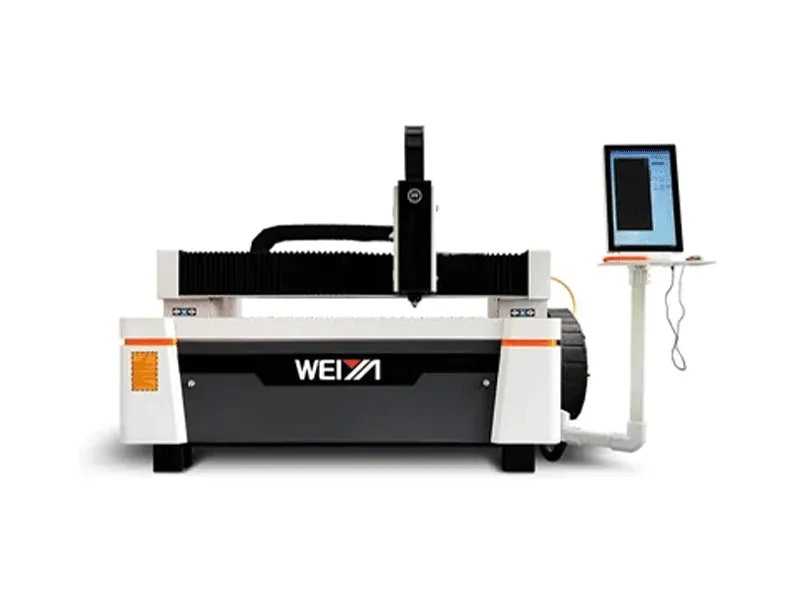
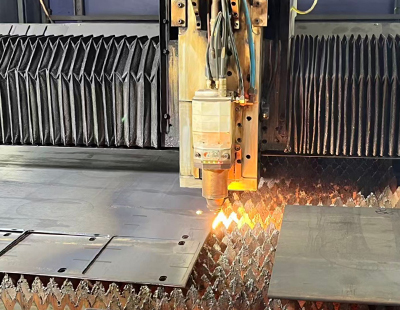
Three axis fiber laser cutters are ideal for fast and efficient cutting of flat sheet metal, often covering common materials such as steel, aluminum, and other non-ferrous metals. They are especially well suited for job shops and OEMs that produce brackets, panels, enclosures, gussets, and other parts that remain flat on the cutting bed.
Five axis laser cutters extend that flexibility into 3D processing by handling formed panels, bent tubes, stamped shells, hydroformed parts, and cast components in one setup. This is particularly useful in automotive and aerospace manufacturing, where components may need angled holes, chamfers, and contours that cannot be reached from a single vertical cutting direction.
For example, a 5 axis laser can trim a deep-drawn body panel, cut window openings, and create angled sensor holes without transferring the part to another machine. That combination of 3D access and non-contact cutting can significantly streamline workflows compared with trimming, drilling, or milling by hand or through separate stations.
5 Axis & 3 Axis Laser Cutting Machines Accuracy and Complexity
In laser cutting, accuracy refers to positioning tolerance and repeatability, while part complexity refers to how intricate a component can be while still being produced in one setup. Both 3 axis and 5 axis systems can achieve high precision, but they excel in different ways.
Industrial laser cutters are capable of very fine positioning accuracy and repeatability, which supports tight dimensional control across both machine types. On well-designed parts, laser cutting can maintain extremely small tolerances, with surface finish also depending on power, speed, and material thickness.
Because laser cutting uses no physical cutting tool, both 3 axis and 5 axis machines can maintain consistent edge quality over long production runs when optics are clean and alignment is stable. However, 5 axis machines introduce additional rotary motion, which means more calibration points and more potential sources of error. Good machine design and quality control are therefore especially important when using 5 axis systems for demanding 3D work.
In terms of complexity, 3 axis machines are limited to cuts that approach the sheet surface from above, which makes undercuts, deep cavities, and multi-angle features difficult or impossible. Five axis machines remove many of these limitations by keeping the beam aligned to the surface normal, allowing accurate cutting of steep walls, beveled edges, and multi-directional contours in a single process.
When to Choose 5 Axis Laser Cutting Machines
A 5 axis laser cutting machine makes sense when your parts, production volume, and downstream operations require multi-angle cutting on 3D forms and a high degree of automation. It is the better choice when the geometry of the part creates limitations for conventional flatbed cutting.
You should consider 5 axis processing if you regularly work on formed components such as automotive pillars, crossmembers, aerospace brackets, or tubular frames that need holes and contours at different angles. In these cases, a 5 axis laser can replace several separate operations, reducing handling, fixtures, and labor while improving consistency.
This type of machine also becomes more attractive when cycle time matters across medium to high production volumes. Because laser cutting can already run at high speed, being able to cut all required features in one clamping amplifies that advantage and makes the total process much more efficient.
If most of your work is flat sheet cutting with simple contours, such as HVAC panels, cabinets, guards, or standard fabricated parts, a high-speed 3 axis fiber laser is usually the more economical and practical option. Many shops achieve the best balance by starting with 3 axis capacity and adding 5 axis equipment later for specialized projects.
5 Axis & 3 Axis Laser Cutting Machines Cost, Programming, and Maintenance
The differences in cost, programming, and maintenance between 5 axis and 3 axis laser cutters mainly come from the extra axes, more advanced motion control, and higher system integration required by 5 axis equipment.
On the investment side, a 3 axis fiber laser cutter is generally much less expensive than a 5 axis system, while advanced 5 axis cells can cost substantially more, especially when robotics and fixtures are included. That higher cost can still be justified when one machine replaces several conventional workstations or supports high-value parts where scrap reduction and accuracy are critical.
Operating costs include electricity, assist gas, consumables, maintenance, and labor. Fiber-based systems are more energy efficient than older CO₂ systems, which helps reduce power consumption in both 3 axis and 5 axis setups. Since 5 axis work is often tied to higher-value parts, shops can usually charge more per hour or per part, which helps offset the larger capital cost.
Programming is also different. A 3 axis laser is relatively straightforward to program because flat patterns can be imported, nested, and converted into cutting instructions with standard software. By contrast, 5 axis programming requires advanced toolpath planning, collision checking, and correct nozzle orientation across 3D surfaces, which increases training needs but also expands production capability.
Maintenance is simpler on fiber laser systems than on older laser technologies because there are fewer optical components and no lamps to replace. Still, 5 axis machines have more rotary axes, sensors, and motion assemblies, so they require more monitoring and calibration. Working with WEIYA can help reduce downtime because service support, spare parts, and remote diagnostics can keep the machine operating reliably.
The best choice between 5 axis and 3 axis machines depends on your typical parts, production scale, and flexibility requirements. Different industries place different value on setup reduction, multi-angle cutting, and throughput.
In automotive and aerospace applications, 5 axis cutting is often the better strategic choice because 3D formed parts can be trimmed and pierced in a single cell, which shortens cycle time and improves dimensional stability. For general fabrication, sheet-metal job shops, contract manufacturers, and OEMs that focus mostly on 2D components, a 3 axis fiber laser usually offers faster payback, simpler staffing, and better throughput relative to investment.
WEIYA supports both directions by providing advanced fiber laser cutting machines and helping customers balance standard 3 axis production with targeted 5 axis capacity for more complex assemblies. That hybrid strategy allows many manufacturers to expand into 5 axis capability without overextending their budgets at the beginning.
Conclusion
For most flat-sheet applications, a 3 axis fiber laser cutting machine remains the most cost-effective, productive, and easy-to-operate solution. However, if your parts include complex 3D forms, angled features, or require multiple secondary operations, a 5 axis laser cutter can lower total part cost and improve quality over the life of the program.
WEIYA's experience in CNC sheet metal machinery and global installations can help customers make this decision using real production data rather than specifications alone. If you share your drawings, annual volume, and current process flow, WEIYA can recommend whether a 3 axis, 5 axis, or combined strategy will deliver the best return for your plant.